Common Social Media Scams: What I Learned the Hard Way
If you’ve ever scrolled through Facebook, Instagram, TikTok, or whatever new app the teenagers invent while I’m still trying to remember my password, you’ve probably run into Common Social Media Scams. I know I have. In fact, I’ve dodged so many scam attempts that I’m starting to feel like the Indiana Jones of the internet — minus the hat, plus a lot more coffee.
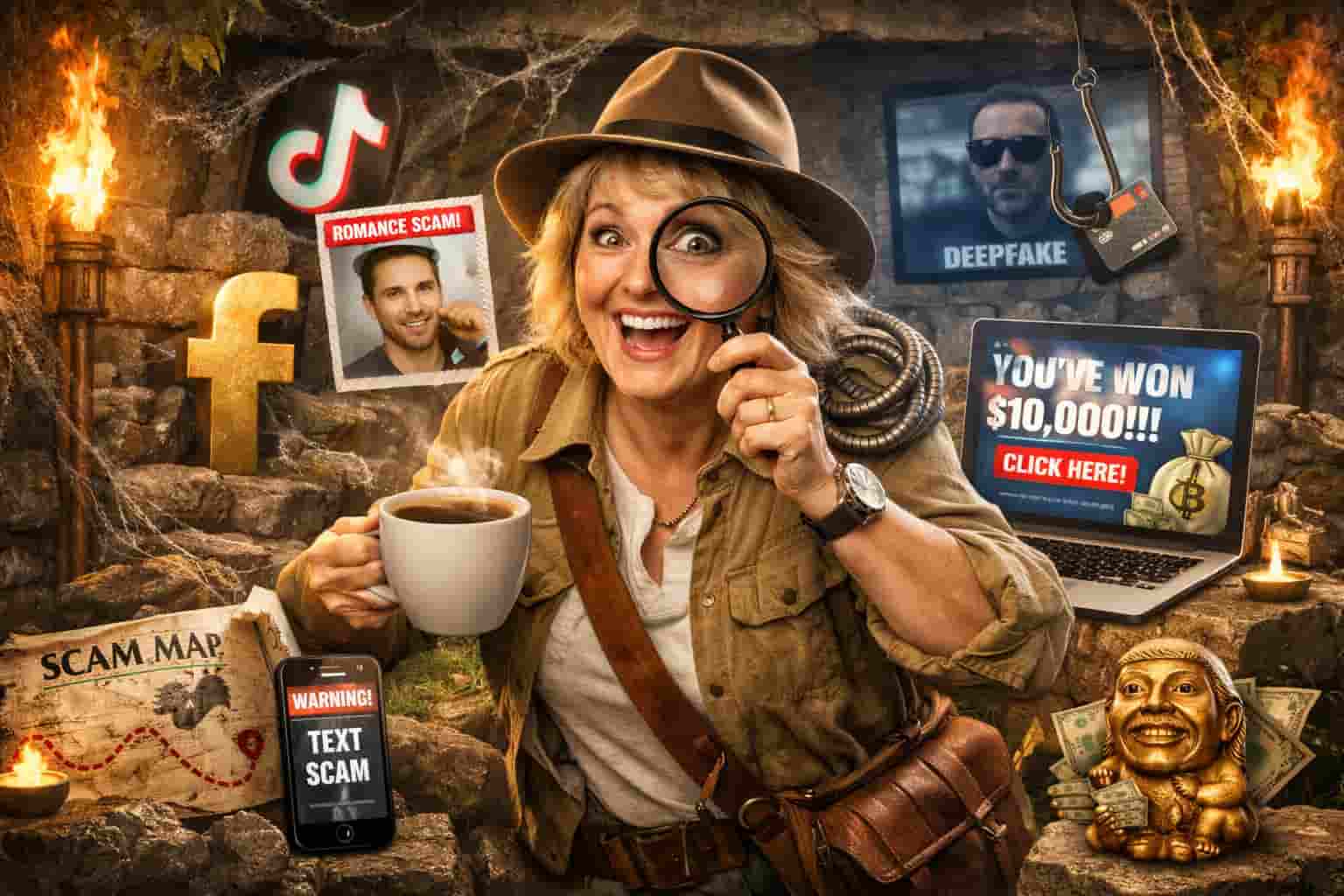
And if you’ve ever gotten a weird text that looks suspicious, you’ll want to read my post on 👉 Common Text Message Scams.
Today I’m breaking down the most 👉 Common money scams I see every single week, how they work, and how you can avoid becoming the next “I can’t believe I fell for that” story at family dinner.
And yes, I’ll sprinkle in humor because if we don’t laugh at the chaos of the internet, we’ll cry.
The Rise of Common Social Media Scams (And Why They’re Everywhere)
Let me tell you something I’ve learned: scammers are basically the overachievers of the criminal world. They wake up early, stretch, drink water, and immediately start inventing new Common Social Media Scams before I’ve even found my slippers.
Why are these scams everywhere?
Because social media is:
- Fast
- Emotional
- Full of strangers
- And full of people who click before thinking (hi, it’s me, I’ve been that person)
Scammers know we’re scrolling quickly, half‑awake, and trusting our “vibes” instead of our logic. That’s why Common Social Media Scams work so well — they’re designed to catch us in the moment.
Fake Giveaways: The Classic of All Common Social Media Scams
Ah yes, the “You just won a free iPhone!” message. I’ve been “selected” for more fake giveaways than I’ve been selected for actual opportunities in real life.
Here’s how this scam works:
- A page pretends to be a celebrity or brand
- They announce a “giveaway”
- They ask you to click a link or send personal info
- You win nothing except regret
These Common Social Media Scams prey on excitement. Who doesn’t want a free iPhone, a free vacation, or a free emotional support alpaca? (Okay, maybe that last one is just me.)
If a giveaway requires:
- Your credit card
- Your Social Insurance Number
- Your firstborn child
…it’s not a giveaway. It’s a trap.
The “Your Friend’s Account Was Hacked” Scam
This one gets me every time because it looks so real. A friend messages you:
“Hey, can you help me vote for my dog in a contest?”
Cute, right? Except the dog doesn’t exist, the contest doesn’t exist, and your friend is currently locked out of their account eating cereal in confusion.
These Common Social Media Scams work because they use trust. You see a familiar face and think, “Sure, I’ll help your imaginary dog win a trophy.”
But the moment you click the link, boom — your account is next.
Romance Scams: Love Is Blind, But Scammers Aren’t
I once had a man on Instagram tell me he loved me after three messages. Three. I can’t even commit to a Netflix show that fast.
Romance‑based Common Social Media Scams usually involve:
- A too‑perfect profile
- A tragic backstory
- A sudden emergency
- A request for money
If someone says:
- “I love you”
- “I’m deployed overseas”
- “My bank account is frozen”
- “Can you send me $300?”
…block them faster than you block spam calls.
Influencer Impersonation Scams: When “Famous People” Slide Into Your DMs
Let me tell you something I never expected in my adult life: the day a “celebrity” slid into my DMs. For one glorious second, I thought I had finally been discovered. Maybe I was about to be invited onto a podcast, or asked to promote a skincare line, or at the very least get a free blender. But no — it was just another one of those influencer impersonation scams that pop up all over social media like dandelions in spring.
These scams are sneaky because they look almost real. The profile photo? Stolen. The username? Off by one letter. The message? Way too friendly for someone with 12 million followers. And the pitch? Always the same:
“Congratulations! You’ve been selected for an exclusive opportunity.”
Translation: “Hand over your money, your info, or your dignity.”
I’ve seen scammers pretend to be everyone from fitness influencers to pastors to lifestyle bloggers. They’ll promise giveaways, mentorship programs, crypto investments, or “exclusive access” to something that definitely does not exist. One even told me I had been chosen to join a private mastermind group. I don’t even mastermind my laundry, so that was my first clue.
These influencer impersonation scams work because they tap into trust. We follow people we admire. We feel like we know them. So when a message pops up from someone we recognize, our brain goes, “Oh wow!” instead of “Wait a minute…” And scammers know that. They count on that split‑second excitement before logic kicks in.
Here’s how I spot them now:
- The account is new or has barely any posts
- The username has extra letters, numbers, or weird punctuation
- The message sounds like a copy‑and‑paste script
- They ask for money, crypto, or “verification fees”
- They want me to click a link that looks like it was generated by a cat walking across a keyboard
Real influencers don’t DM strangers asking for money. They don’t run secret giveaways. And they definitely don’t need me to “verify my identity” by entering my credit card number. If Beyoncé wants to talk to me, she can call me directly — until then, I’m assuming every DM is a scammer with too much free time.
These scams are becoming one of the most Common Social Media Scams because they’re easy to set up and hard for people to spot. But once you know the signs, you’ll start seeing through them faster than I see through a “limited‑time offer” at 2 a.m.
Marketplace Scams: Where Good Deals Go to Die
I love a bargain, but Facebook Marketplace has taught me that if something looks too good to be true, it’s probably being sold by a scammer in a basement somewhere.
Common tactics:
- Fake listings
- Stolen photos
- “I’ll ship it to you!”
- “Please pay a deposit first”
These Common Social Media Scams are sneaky because they use real‑looking items. But if the seller refuses to meet in person or wants payment before you even see the item, run.
Job Offer Scams Over Social Media
I swear, if I get one more “We saw your profile and think you’d be perfect for our remote position!” message, I might start charging scammers a consulting fee.. These 👉 job offer scams over social media are sneaky because they look professional — shiny logos, fake HR accounts, and messages that sound like real recruiters.
Here’s how they usually go down:
- You get a DM from “HR” at a big company.
- They say they found your profile and want to hire you immediately.
- They ask for your email, phone number, or even banking info “for payroll setup.”
- Then poof — they vanish faster than your motivation on a Monday morning.
Beware of job offer scams because they are one type of make money fast scams you want to stay away from.
Crypto & Investment Scams: The “I Made $10,000 Overnight!” Lie
If someone on Instagram DMs you saying they turned $200 into $10,000 overnight, I promise you they did not. The only thing they’re multiplying is the number of people they scam.
These Common Social Media Scams usually involve:
- Fake trading accounts
- Fake screenshots
- Fake testimonials
- Real victims
If someone claims they can “flip your money,” the only thing getting flipped is your bank account balance — straight to zero.
AI Deepfake Scams: The New Kid on the Block
This one is wild. Scammers now use AI to create fake videos of celebrities, pastors, influencers, and even your own friends.
They’ll say:
- “Invest in this!”
- “Click this link!”
- “Buy this product!”
These Common Social Media Scams are dangerous because the videos look real. But trust me — if Oprah didn’t personally call you, she’s not asking you to invest in anything.
Fake Charity Scams: When Scammers Pretend to Save the World (But Really Want Your Wallet)
I’m all for helping people. Truly. If someone needs a meal, a warm coat, or a hug, I’m there. But the internet has turned “charity” into a full‑time scammer playground, and I’ve seen enough fake charity scams to last me several lifetimes. These scammers pop up after every disaster, every trending news story, and every emotional moment online — like emotional vultures circling the comments section.
Here’s how it usually goes:
You’re scrolling, minding your own business, maybe sipping your coffee, when suddenly you see a heartbreaking post. A sick child. A family who “lost everything.” A dog with a cast on its paw. And right below it? A link to donate. Except the link looks like it was created by someone smashing their keyboard with a frying pan.
These fake charity scams are designed to hit you right in the feelings. Scammers know that when people are emotional, they’re generous. And when they’re generous, they click fast. I’ve seen fake GoFundMe pages, fake “official relief funds,” and even fake church donation pages. One scammer even tried to convince me that a celebrity was personally raising money through a random PayPal link. Sure, Jan.
The biggest red flags I’ve learned to spot:
- The charity name sounds like a knockoff brand (“International Global Relief Worldwide Foundation of Hope” — okay, calm down)
- The page was created yesterday
- The photos are stolen from Google
- The donation link goes to a personal account
- The story is vague, dramatic, and full of typos
- They pressure you with “Donate NOW before it’s too late!”
Real charities don’t beg like that. Real charities have websites, transparency, and tax receipts. Fake charities have desperation and emojis.
These scams explode during natural disasters, holidays, and viral tragedies. And honestly, it makes me furious — not just because scammers are stealing money, but because they’re stealing trust. They make people afraid to give, even when real people need help.
- Now, whenever I see a charity link on social media, I do a quick check:
- Is the organization registered?
- Does the link go to a real website?
- Does the story make sense?
- Does the page look like it was made by someone who knows how to use punctuation?
If not, I scroll right past it like it’s a gym membership ad.
Fake charity scams are some of the most Common Social Media Scams because they work. But once you know the signs, you’ll never fall for them again — and you’ll still be able to support real causes without accidentally funding a scammer’s vacation.
Phishing Scams: When Clicking the Wrong Link Feels Like Stepping on a Lego
If there’s one thing I’ve learned from years of being chronically online, it’s this: phishing scams are everywhere. They’re like glitter — once they show up, they get into everything. Your inbox, they can be scams in your email, your DMs, your comments, your notifications. I swear, if I open my fridge one day and find a phishing link taped to the milk, I won’t even be surprised.
Phishing scams are the kings of Common Social Media Scams because they’re simple and effective. Scammers send you a link that looks legit, you click it, and suddenly they’re inside your account faster than you can say “Why is my profile picture now a Bitcoin logo?”
These scams usually start with something urgent:
- “Your account will be deleted in 24 hours!”
- “You violated community guidelines!”
- “Someone tried to log into your account!”
- “Click here to claim your prize!”
And because we’re human, we panic. Or we get curious. Or we think, “Well, maybe I did win something for once.” And boom — we click.
I’ve clicked a suspicious link before. I’m not proud, but I’m honest. One time I clicked a link that claimed someone reported my account. I was half‑asleep, holding my phone at an angle that would make a chiropractor cry, and I clicked before my brain woke up. The page looked real for about two seconds — then it asked for my password. That’s when my brain finally clocked in for work.
Phishing scammers are getting smarter, too. They use:
- Fake login pages
- Fake verification forms
- Fake customer support accounts
- Fake “security alerts”
- Fake brand pages
Basically, if it’s fake, they’ve made it.
Now I follow one simple rule:
If a link makes me feel rushed, scared, or excited, I don’t click it.
Scammers love emotions. Logic ruins their whole business model.
I also hover over links (or long‑press on mobile) to see where they really go. If the URL looks like “insta‑verify‑secure‑login‑help‑support.ru,” I’m out. If it looks like someone typed it with their elbows, I’m out faster.
Phishing scams are annoying, sneaky, and everywhere — but once you learn to spot them, they lose all their power. And trust me, nothing feels better than deleting a scam message like you’re swatting a mosquito.
How I Protect Myself From Common Social Media Scams
Here’s my personal checklist — simple, effective, and created after years of learning the hard way:
- I never click links from strangers
- I double‑check profiles for weird usernames
- I ignore “urgent” messages
- I assume every giveaway is fake until proven otherwise
- I trust my gut (and my gut is suspicious of everyone online)
These habits have saved me from countless Common Social Media Scams, and they’ll save you too.
Final Thoughts: The Internet Is Wild, But You Can Stay Safe
Social media is fun, chaotic, and occasionally full of people trying to steal your money. But once you know the signs of Common Social Media Scams, you can scroll with confidence — and maybe even laugh at how ridiculous some of these scam attempts are.
Stay alert. Stay skeptical. And if someone offers you a free iPhone, just remember: nobody gives away a $1,000 phone for clicking a heart emoji.
FAQ: Common Social Media Scams
1. What are the most common social media scams right now?
The biggest ones I see every week are fake giveaways, hacked‑friend messages, romance scams, crypto scams, deepfake videos, and job offer scams pretending to be “HR.” If it feels too good to be true, it probably has a scammer behind it drinking iced coffee and typing fast.
2. How do scammers contact people on social media?
They slide into your DMs like they’re auditioning for a reality show. Messages, comments, fake profiles, fake ads — scammers use anything that gets your attention while you’re half‑awake scrolling.
3. How can I tell if a message is from a scammer?
Look for red flags: urgency, weird grammar, requests for money, links that look like alphabet soup, or someone who “loves you” after three messages. Real people don’t talk like that.
4. Are job offers on social media legit?
Some are, but many are Common Job Offer Scams pretending to be recruiters. If they ask for banking info before an interview, run. If they offer a job you never applied for, run faster.
5. What should I do if I clicked a suspicious link?
Don’t panic — but do act fast. Change your passwords, enable two‑factor authentication, and check your accounts for weird activity. If things look messy, report it to the platform and your country’s fraud center.
Helpful Resources
If you want more information on staying safe from online scams, here are two trusted resources from both Canada and the United States:
- Government of Canada – Avoiding Scams and Fraud
- USA Federal Trade Commission (FTC) – Online Scams & Fraud Prevention